Investing Along the S-Curve
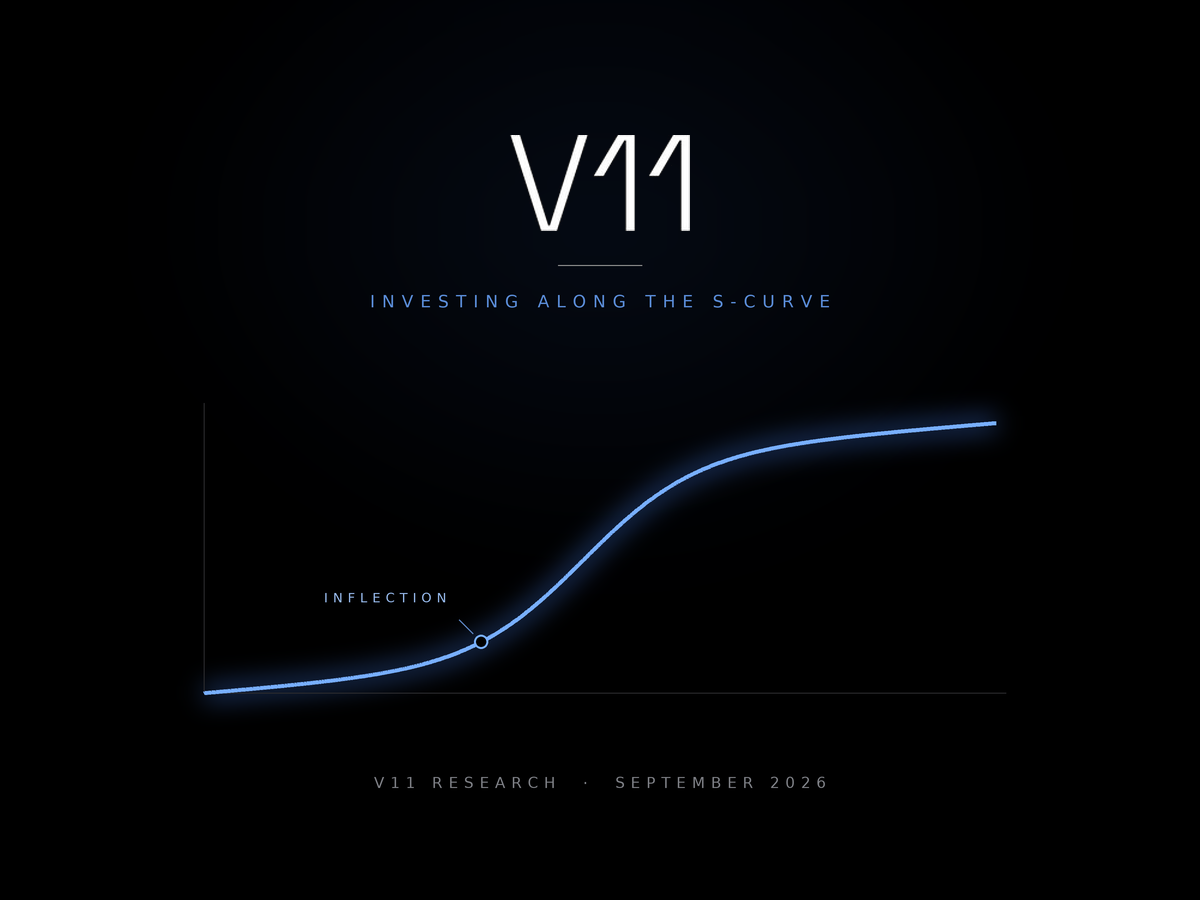
Technological progress is rarely linear. Many of the most important technologies follow an S-curve of adoption: a long period of slow, uneven progress, followed by rapid acceleration, and eventually a period of maturity as adoption approaches saturation.
For investors, understanding where a technology sits on that curve can matter as much as understanding the technology itself.
The Shape of Adoption
At the beginning of an S-curve, adoption is typically slow. The technology may be expensive, difficult to deploy, poorly understood, or dependent on infrastructure that does not yet exist. Early users are often highly technical, unusually motivated, or willing to tolerate an imperfect product.
Progress during this phase can appear incremental. Then something changes. Costs fall. Performance improves. Infrastructure matures. Distribution expands. Regulation becomes clearer. The product becomes easier to use.
Several constraints can disappear at once. What previously looked like gradual progress can quickly become exponential adoption.
This is the steepest part of the S-curve—the point where a technology begins moving from early adoption toward mainstream deployment.
Eventually, growth slows again. Markets mature, penetration increases, competition intensifies, and the technology becomes increasingly standardized.
Why Inflection Points Matter
The most interesting investment opportunities often emerge around technological inflection points. Too early, and a technology may spend years waiting for the ecosystem around it to become viable. Too late, and much of the growth may already be reflected in valuations and competitive positioning.
The opportunity is often in identifying when several enabling factors begin converging at the same time.
These can include:
Performance thresholds. A technology becomes materially better than the incumbent rather than merely different.
Falling costs. Production, compute, hardware, or deployment costs decline enough to unlock new use cases.
Infrastructure readiness. Complementary technologies become sufficiently developed to support broader deployment.
Distribution. Products become easier to access, integrate, and adopt.
Behavioral change. Customers become willing to change established workflows.
When these conditions align, adoption can move rapidly.
Artificial Intelligence as an Example
Artificial intelligence illustrates this dynamic clearly. Machine learning research existed for decades before the current wave of adoption. But improvements in computing infrastructure, model architectures, data availability, developer tooling, and capital investment eventually converged.
The result was not simply better AI models. It was a dramatic expansion in the number of economically viable applications. The same pattern is now beginning to influence adjacent sectors.
In robotics, better models, cheaper sensors, improved hardware, and stronger compute infrastructure are increasing the range of tasks machines can perform.
In biotechnology, advances in computation and biological data are changing how researchers discover and design therapies.
In industrial automation, software and AI are increasingly moving beyond digital workflows and into physical systems.
Each market follows its own curve, but the underlying pattern is similar.
Not Every S-Curve Creates the Same Investment Opportunity
Rapid adoption alone does not guarantee attractive returns. As a market accelerates, investors still need to understand where value is captured.
Some technologies create enormous markets while producing relatively weak economics for individual companies. Others develop durable competitive advantages through proprietary data, scale, distribution, network effects, intellectual property, or deep integration into customer workflows.
The key question is therefore not simply: Will this technology become important?
It is: Which companies will capture disproportionate value as adoption accelerates?
That distinction becomes increasingly important during periods of technological enthusiasm, when the growth of a category can sometimes be mistaken for the strength of every company operating within it.
Looking for the Next Curve
Technological leadership is rarely permanent. As one S-curve matures, another often begins underneath it. New architectures replace old ones. New cost structures emerge. New products make previously uneconomic markets viable. The transition between curves can create both risk and opportunity. Incumbents often optimize around the existing technology curve. Emerging companies may instead be building around a fundamentally different one.
For long-term investors, the goal is not simply to identify technologies that are growing. It is to understand which technological curves are approaching an inflection point, what is causing that inflection, and which companies are positioned to benefit disproportionately from it.
At V11, we believe some of the most compelling opportunities in technology investing emerge when fundamental technological progress begins translating into accelerating real-world adoption.
That is often where an S-curve becomes most interesting.