Our Thesis

We back category-defining companies in massive markets where deep moats and exceptional execution create asymmetric, risk-adjusted return potential.
The Problem In Venture
The venture market has become increasingly crowded, with more capital and more VC firms. Yet returns still come from a small group of outlier companies, and access to those companies often goes to investors who bring strategic value or have differentiated access.
As a result, most venture firms are left competing for the remaining opportunities: companies with weaker moats, smaller markets, or limited technological differentiation that are less likely to generate venture-scale returns. This is why venture returns remain so concentrated.
V11’s strategy is built around three principles: identifying foundational technologies, building a broad network to create differentiated access to these opportunities, and using that network to develop differentiated technical insight. We believe this is how the best investment opportunities are found.
Our Approach
I - Venture Returns Come From Breakthrough Innovation
The companies that generate outsized returns are rarely those making incremental improvements. They are businesses building foundational technologies, creating new markets, and solving problems that were previously impossible to address.
V11 focuses on companies developing transformative technologies where deep engineering complexity creates barriers to entry, durable competitive advantages, and the potential for asymmetric outcomes. We are particularly attracted to technologies that cross critical performance and cost thresholds, unlocking new markets and becoming the foundation for future innovation.
The best private-market opportunities rarely circulate broadly; they move through trusted networks of founders, fund managers, operators, executives, and long-term shareholders.
V11 continuously cultivates relationships across the venture ecosystem by operating with speed, discretion, reliability, and strategic value. This network provides differentiated access to investment opportunities that are often unavailable through traditional channels.
II – The Best Opportunities Are Hard to Access
A strong network provides more than investment opportunities; it can reveal differentiated insights. By engaging with founders, technical experts, operators, investors, and industry participants, investors can better understand which technologies are advancing, which barriers are being overcome, and where the market may be underestimating a company’s potential.
V11 uses its network to build a more open, interdisciplinary perspective on emerging technologies. We believe this gives us differentiated insights into foundational companies whose capabilities, competitive advantages, or market opportunities remain misunderstood, creating the potential for attractive mispricing and asymmetric returns.
III – Networks Reveal Differentiated Insights
Investment Strategy
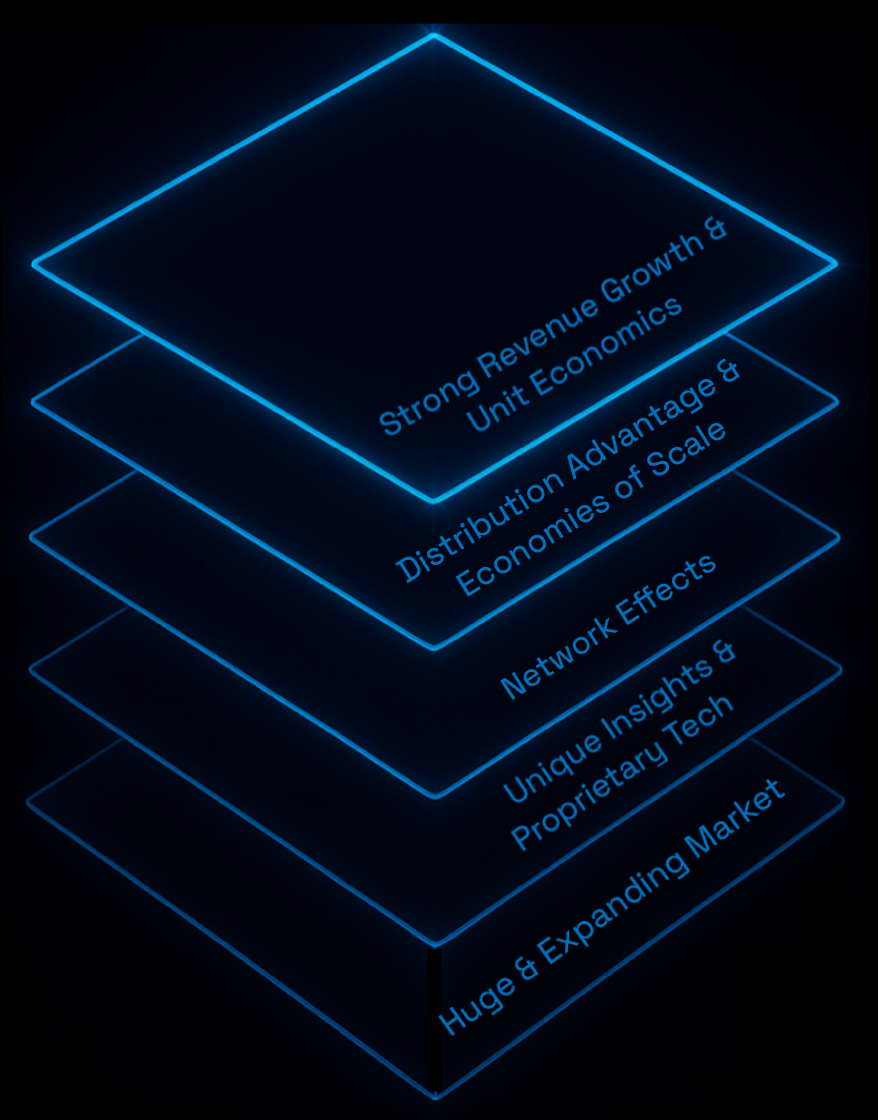
We invest in companies operating in massive, expanding markets with proprietary technology at their core. We look for products that generate network effects through people, usage, or data, creating compounding value as the ecosystem grows. As these companies scale, distribution advantages and economies of scale drive down marginal costs and accelerate efficiency. Over time, this foundation translates into superior unit economics, strong revenue growth, and a trusted brand that reinforces loyalty and long-term defensibility.
Where We Invest
-
AI adoption is accelerating across every industry as enterprises move from experimentation to full operational deployment. Falling compute costs, rapid model efficiency gains, and the rise of AI agents are transforming workflows, automating decision-making, and unlocking new productivity levels. With organizations integrating AI into core business functions, demand is compounding and creating one of the largest technology waves of the decade.
-
Robotics and autonomous drones are entering a breakout phase as hardware costs fall, sensors improve, and AI enables real-time perception and decision-making. Enterprises are rapidly deploying delivery drones, warehouse robots, and early humanoids to reduce labor shortages and improve efficiency. With global infrastructure and logistics companies scaling adoption, the category is moving from pilots to full commercial rollout, creating one of the strongest long-term growth curves in modern technology.
-
The global energy sector is being reshaped by the explosive demand for AI compute, electrification, and next-generation infrastructure. Data centers, EV fleets, and industrial automation are driving massive new loads that legacy grids cannot support. This shift is accelerating investment into renewables, long-duration storage, small modular reactors, and early fusion technologies. As the world races to build the energy backbone for the AI era, the category is entering its largest growth cycle in decades.
-
Space technology is accelerating as launch costs continue to fall, satellite constellations scale globally, and commercial players take over missions once reserved for governments. New capabilities in Earth observation, communications, in-orbit manufacturing, and microgravity research are opening multi-billion-dollar markets. With defense, climate monitoring, logistics, and AI all relying on space-based infrastructure, the sector is entering a long expansion cycle driven by commercial demand and national security priorities.
-
AI is compressing drug discovery timelines and expanding therapeutic possibility in ways the legacy pharma model cannot match. Computational methods are unlocking previously intractable biological problems — accelerating the path from target identification to clinical candidate by years. The companies applying these tools to create entirely new drug categories represent some of the most asymmetric opportunities in private markets today.
How We Invest
-
Series B+, Secondaries
-
United States, Europe
-
$1M - $5M
V11 is built to focus on and access the small group of companies capable of generating venture-scale outcomes. We focus on foundational technologies in massive markets, where technical complexity creates durable competitive advantages and where the broader market may misunderstand the opportunity.
By combining differentiated access, deep network-driven insight, and disciplined underwriting, we aim to invest in category-defining companies before their full potential is reflected in the market. Our goal is not to participate broadly in venture, but to concentrate capital in exceptional companies with the potential to compound value and generate asymmetric returns.
Conclusion
V11
675 Bering Dr, Ste 550
Houston, TX 77057
United States